

Obesity and Climate Change: Why Our Food Choices Matter More Than Ever
A Daily Wellness with Wisdom: A Perspective on Health, Nutrition, and the Future
In today’s fast-paced world, many people feel exhausted, mentally foggy, and disconnected from their bodies. At the same time, global conversations around obesity and climate change are becoming louder and more urgent. What many people don’t realize is that these two crises are deeply connected—and the link lies largely in how we eat and how our food is produced.
At Daily Wellness with Wisdom, we approach health through wellness with a wisdom mindset—one that looks beyond quick fixes and asks deeper questions about nourishment, balance, and long-term wellbeing. This article examines the impact of modern food systems on our bodies, minds, and planet, and how making gentle, informed choices can help restore both personal health and collective harmony.
The Global Obesity Crisis: More Than a Personal Health Issue
Obesity has reached unprecedented levels worldwide. Today, over 2.6 billion people are living with excess weight or obesity, and projections suggest that within the next decade, one in every two adults globally may be affected.
This is not simply about appearance or lack of discipline. Obesity is a chronic health condition linked to:
- Type 2 diabetes
- Heart disease and stroke
- Certain cancers
- Joint and mobility challenges
- Fatigue and reduced quality of life
- Anxiety, depression, and emotional distress
What is especially concerning is the rapid rise of obesity among children and adolescents, placing them at risk for lifelong health struggles before adulthood even begins.

The Food Environment Has Changed—and Our Bodies Are Responding
Human biology has not changed significantly in the last few decades, yet obesity rates have skyrocketed. This tells us something important: the environment has changed faster than our bodies can adapt.
One of the most significant shifts has been the increasing dominance of ultra-processed foods in modern diets.
These foods are designed for convenience, shelf life, and profit—not nourishment. They are often made from refined ingredients, additives, preservatives, artificial flavorings, and sweeteners that provide calories but very little real nutrition.
As ultra-processed foods have replaced traditional, home-prepared meals, many people now experience:
- Constant hunger despite eating enough calories
- Energy crashes throughout the day
- Poor digestion and gut health
- Brain fog and reduced focus
- Disrupted appetite signals
This is where nutrition for mental clarity becomes especially important. What we eat directly affects how we think, feel, and function.
Ultra-Processed Foods and Their Impact on Mental and Physical Energy
Highly processed foods are engineered to be hyper-palatable, meaning they stimulate reward centers in the brain in ways similar to addictive substances. Over time, this can disrupt natural hunger and fullness cues.
These foods are typically:
- High in refined sugars and unhealthy fats
- Low in fiber, protein, and micronutrients
- Easy to overconsume quickly
Research consistently links high consumption of ultra-processed foods to weight gain, metabolic disorders, and mental health challenges such as depression and anxiety.
In contrast, diets rich in natural energy foods—such as vegetables, fruits, legumes, whole grains, nuts, seeds, and healthy fats—support stable blood sugar levels, sustained energy, and improved mood.
True energy does not come from stimulants or sugar spikes. It comes from real nourishment.
Obesity, Mental Health, and the Mind–Body Connection
One of the most overlooked aspects of obesity is its strong connection to mental health. Many people living with excess weight experience:
- Low self-esteem
- Emotional eating
- Chronic stress
- Anxiety and depressive symptoms
At the same time, poor mental health can drive unhealthy eating patterns, creating a difficult cycle. This is why wellness with a wisdom mindset matters—it recognizes that healing is not just physical, but emotional and psychological as well.
Nutrition plays a key role in mental clarity. Diets lacking fiber, healthy fats, and micronutrients can impair gut health and brain function, while whole foods support neurotransmitter balance, focus, and emotional resilience.
The Hidden Link Between Obesity and Climate Change
What we eat doesn’t only affect our bodies—it affects the planet.
The same food systems driving obesity are also major contributors to:
- Greenhouse gas emissions
- Deforestation
- Water pollution
- Biodiversity loss
Highly processed foods require intensive manufacturing, packaging, transportation, and energy use. Industrial meat production, in particular, places enormous strain on the environment.
In contrast, diets centered around plant-based, minimally processed foods are associated with:
- Lower environmental impact
- Improved metabolic health
- Better digestion and sustained energy
When we choose nourishing foods, we are making a decision that supports both personal wellness and planetary health.
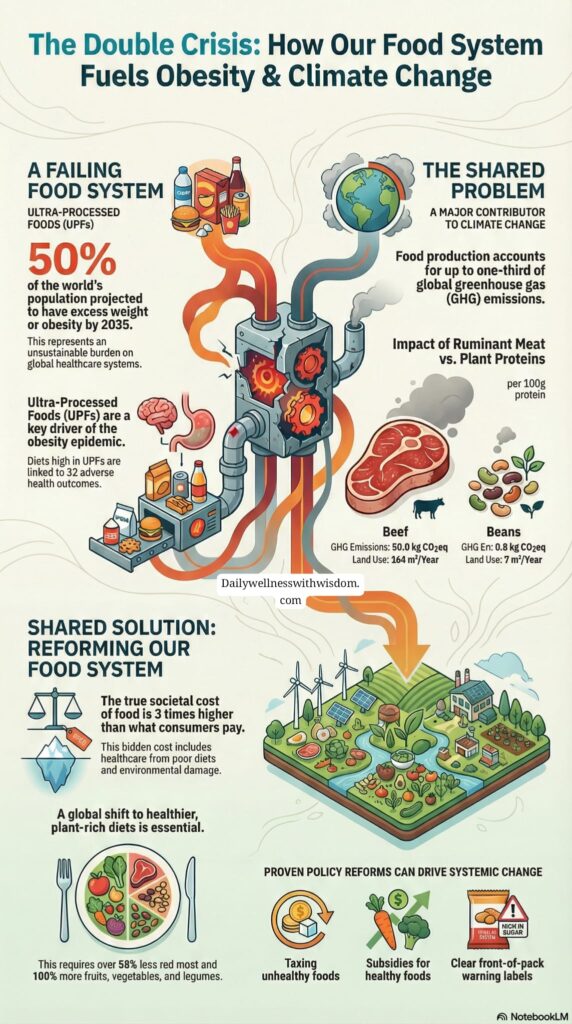
This article is informed by evidence from the paper cited below: Obesity and climate change: Samaras K and co-crises with common solutions. Front Sci (2025)
Why Medication Alone Is Not the Answer
Recent advances in weight-loss medications and surgical interventions have helped many people manage obesity. These tools can be valuable for individuals with severe health risks.
However, they cannot replace prevention.
Relying solely on medication without addressing the food environment means:
- Treating symptoms instead of causes
- Creating long-term dependence
- Ignoring social and environmental responsibility
A sustainable solution requires rebuilding food systems that make healthy choices the easiest choices.
A Wisdom-Based Approach to Food and Wellness
Lasting health is not built on restriction, shame, or extremes. It is built on awareness, balance, and compassion.
A wellness with a wisdom mindset encourages us to:
- Eat foods that nourish both body and mind
- Listen to hunger and fullness cues without guilt
- Choose quality over convenience when possible
- Understand that progress matters more than perfection
Simple shifts—like cooking more at home, reducing sugary drinks, increasing fiber intake, and prioritizing natural energy foods—can have profound effects over time.
Practical Steps Toward Nutrition for Mental Clarity and Sustainable Wellness
You don’t need to change everything at once. Start gently:
- Add more whole foods to your meals, one choice at a time
- Focus on foods that support stable energy and clear thinking
- Reduce reliance on packaged snacks and sugary drinks
- Eat slowly and mindfully when possible
- Remember that nourishment is an act of self-respect
These small, consistent choices support not just weight balance, but mental clarity, emotional wellbeing, and long-term vitality.
Final Reflection: Wellness Is a Collective Responsibility
Obesity and climate change are not individual failures. They are signs that our systems need healing.
When we approach food with wisdom, we reclaim our health without punishment. When we choose nourishment over excess, we protect future generations.
This is the heart of Daily Wellness with Wisdom—a gentle reminder that true wellness is thoughtful, informed, and deeply connected to how we live, eat, and care for the world around us.
Daily Wellness with Wisdom.
Obesity and Climate Change: Why Our Food Choices Matter More Than Ever.
Daily Wellness with Wisdom Blog, 2026.
References & Further Reading:
Academic & Global Health Sources
- World Health Organization (WHO).
Obesity and Overweight – Global Health Facts and Trends. - Swinburn, B. A., et al.
The Global Syndemic of Obesity, Undernutrition, and Climate Change.
The Lancet Commission Report. - Monteiro, C. A., et al.
Ultra-Processed Foods, Diet Quality, and Health Using the NOVA Classification System.
Public Health Nutrition. - Hall, K. D., et al.
Ultra-Processed Diets Cause Excess Calorie Intake and Weight Gain.
Cell Metabolism. - Food and Agriculture Organization of the United Nations (FAO).
Sustainable Diets and Biodiversity. - Jacka, F. N., et al.
A Randomized Controlled Trial of Dietary Improvement for Adults with Major Depression.
BMC Medicine. - Mayer, E. A.
The Gut–Brain Connection.
Harvard Health Publishing. - Mozaffarian, D.
Dietary and Policy Priorities for Cardiovascular Disease, Diabetes, and Obesity.
Circulation Journal. - Intergovernmental Panel on Climate Change (IPCC)
- Willett, W., et al.
- Food in the Anthropocene: The EAT–Lancet Commission on Healthy Diets from Sustainable Food Systems.
- Behrens P, Champagne CM, Halford JCG, Moodie M, Proietto J, Rutter GA, Holly JMP. Obesity and climate change: Samaras K and co-crises with common solutions. Front Sci (2025) 3:1613595. doi: 10.3389/fsci.2025.1613595